What does excess mean in car insurance? It's the amount you pay towards a claim. Learn how excess works and how to choose the right one for you.
The short answer: your excess is the amount you pay towards a claim, before your insurer covers the rest.
That's the whole concept. The rest of this guide is about the bit that actually matters: how to pick an excess that keeps your premium down without leaving you stuck when you need to claim. If you've ever seen the word "deductible", by the way, it's the same thing.
The short version
- Your excess is your share of a claim. You pay it, your insurer covers the rest.
- A higher excess means a lower monthly premium. A lower excess means a higher one.
- You pay it every time you claim, either to the panel beater or as a deduction from your payout.
- There's no perfect excess. Pick the most you could comfortably cover if you had to claim tomorrow.
What is an insurance excess?
Your excess is the amount of money that will come out of your pocket when you make a claim. Think of it as the contribution you have to make; your insurer will then pay the remaining balance on your car insurance claim.
How does a car insurance excess work?
You pay a fixed amount towards your claim, and your insurer pays the rest.
Picture this: you misjudge a parking bay and scrape the side of your car. The repair comes to R20,000. With a R5,000 excess, you pay R5,000 and your insurer covers the other R15,000. Simple as that.
It works the same whether it's a knock, a theft, hail damage, or a write-off. The excess is your slice, every time.
What happens if the repair costs less than your excess?
Then it's usually not worth claiming. If a shopping trolley leaves a R3,000 dent and your excess is R5,000, you'd be paying for the whole repair yourself anyway, so there's no point opening a claim. You'd sort it out privately and keep your claims record clean.
What types of excess are there?
Insurers structure excess in a few different ways. It's worth knowing them, because this is where the nasty surprises usually hide.
Compulsory vs voluntary excess
Your compulsory (or basic) excess is the standard amount that applies to your claims. A voluntary excess is an amount you choose to add on top, in exchange for a lower premium. The two below are simply how that amount gets worked out.
Flat amount excess
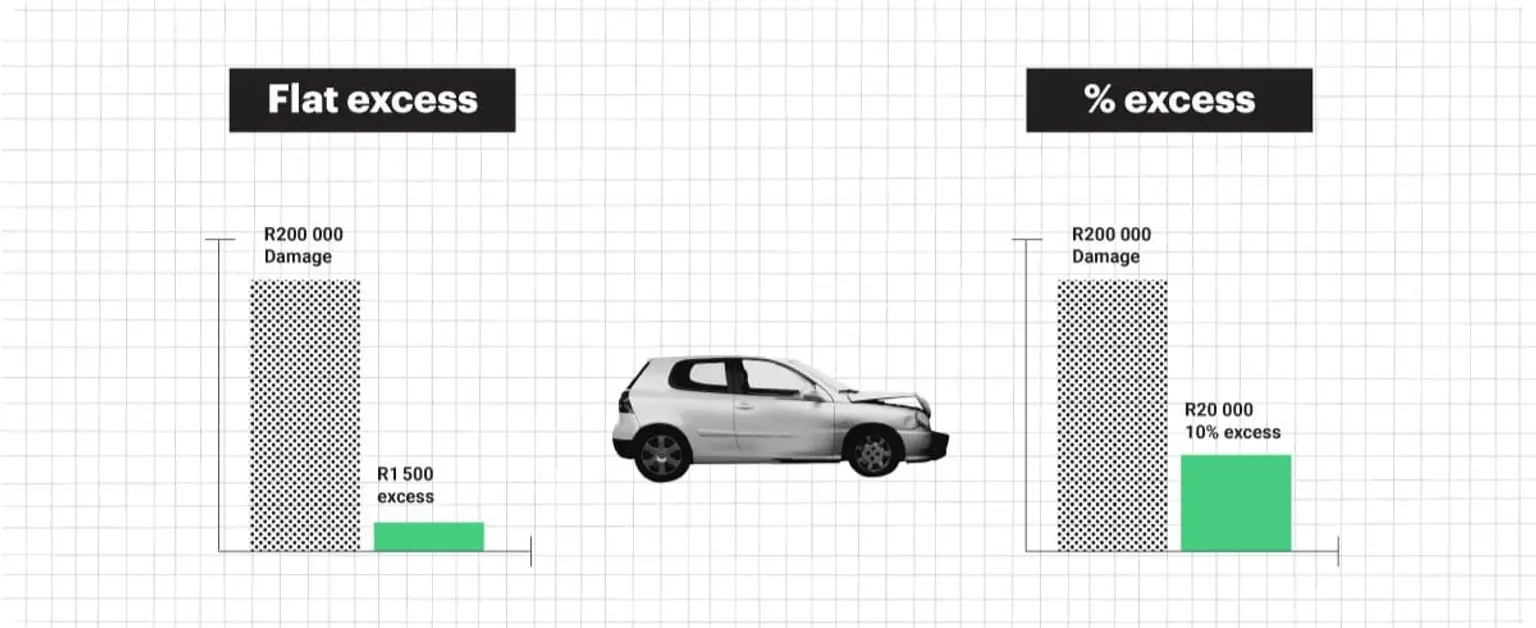
You pay a set rand figure on every claim, whatever it's worth. A R3,000 excess means R3,000 each time.
Percentage of the claim excess
Here your excess is a percentage of the claim, so it moves with the size of it. A 10% excess on a R100,000 claim is R10,000. The catch: it's hard to budget for and it can balloon fast. If your R350,000 car is stolen, that's R35,000 out of your pocket.
Additional or special excess
Some insurers tack on extra in certain situations: a driver under 25, a licence held for under two years, a late-night accident, or a driver not listed on the policy. These are the "hidden excesses" buried in the small print, and they're exactly the thing that wrecks a budget at claims stage.
Glass and windscreen excess
Glass is often treated differently. At Naked, glass claims under R2,000 have no excess, claims between R2,000 and R3,000 carry an excess of the claim amount less R2,000, and claims over R3,000 have a R1,000 excess.
How do you choose your excess?
Start with one question: what's the most you could comfortably pay out of pocket if you had to claim tomorrow? That number is your excess.
It's a balancing act. A lower excess saves you at claims stage but costs more every month. A higher excess does the opposite. It's one of the bigger levers on what you pay each month, so it's worth getting right.
Do the math: say dropping your excess from R6,000 to R3,000 adds roughly R80 to your premium each month. That's about R960 a year to save R3,000 at claims stage. If you go more than three years without claiming, the lower excess has quietly cost you more than it saved. If you claim sooner, it's paid for itself. Neither is "right", it depends on how the odds and your budget line up for you.

Consider a higher excess if:
- You've got enough set aside to cover it without flinching.
- You rarely claim and want the lowest monthly premium you can get.
- Your car spends a lot of time parked, so small knocks are less likely. If that's you, CoverPause is worth a look, since it lets you pay less when your car's off the road.
Consider a lower excess if:
- A surprise bill of a few thousand rand would stretch you.
- You're in stop-start traffic every day, so the odds of a small claim are higher.
- You'd rather pay a bit more monthly for predictability.
Higher or lower excess: which is better?
A higher excess is better if you want a lower monthly premium and could cover the bigger amount when you claim. A lower excess is better if you'd rather keep your out-of-pocket surprises small and don't mind paying more each month.
There's no universal answer. You're really choosing between paying a little more every month or paying more on the day you actually need it. Pick whichever sits easier with your budget.
Why do you pay an excess at all?
Excess keeps premiums affordable and keeps everyone a bit more careful. Because you're covering part of every claim, you've got skin in the game. It also filters out tiny claims, which are expensive to process, and fewer of those means lower premiums for everyone. So your excess is quietly working in your favour.
When do you pay your excess?
Every time you claim. It either comes off your payout or you pay it directly.
Picture two scenarios. A hailstorm hammers your car overnight and the repair comes to R18,000: you'd pay your excess to the panel beater when you collect it. Your R300,000 car gets stolen and never recovered: with a R5,000 excess, you'd be paid out R295,000, the excess simply deducted. If you still owe more than the payout on your car finance, that gap is where shortfall cover comes in.
Do you still pay an excess if the accident wasn't your fault?
Yes, at first, but you'll usually get it back. You pay your excess so your car gets fixed straight away instead of waiting on a legal process. If the other driver is found at fault, your insurer recovers the costs and refunds your excess. Heads-up: that recovery can take a few months, since it tends to involve lawyers and the courts.
What if you can't afford your excess after an accident?
It depends on your insurer, and that's the whole reason this matters. Some offer a payment plan. Others won't start repairs, or won't release your car, until the excess is paid, which can leave you without a car right when you need one most. Choose an excess you could genuinely cover on the day, and you sidestep the problem entirely.
Can you change your excess?
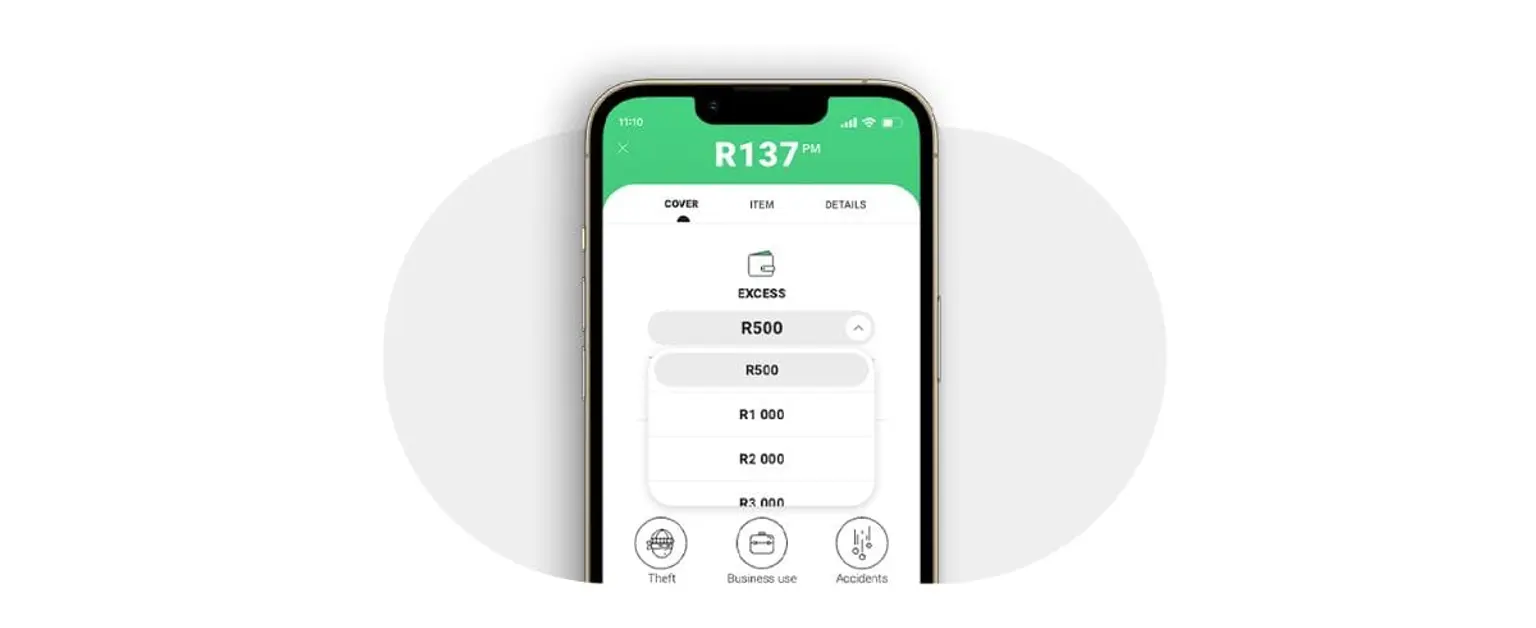
Yes. With Naked, you can adjust your excess anytime on the app and see what it does to your premium on the spot. As your finances shift, your cover can shift with them. Bumping your excess down will lift your premium, and pushing it up will lower it. Not sure which cover suits you in the first place? Here's what type of car insurance you need.
Before we go
Excess isn't the scary part of insurance it's made out to be. It's one dial you get to set: a bit more risk for a lower premium, or a bit more certainty for a higher one. Get it level with what you could comfortably pay on the day, and you've got cover you can actually rely on.
Got a question? Drop us a line at help@naked.insure.
Frequently asked questions
Is an excess the same as a deductible?
Yes. "Deductible" is the word used in some countries, but it means the same thing: the portion of a claim you pay yourself.
Does my excess reset every year like a medical aid?
No. Excess isn't annual. It applies per claim, so if you claim twice in a year, you'll pay it twice.
Do I pay my excess to my insurer or the panel beater?
For repairs, you pay the panel beater when you collect your car. For a theft or write-off, it's deducted from your payout instead.
Can I get car insurance with no excess?
Most cover carries some excess, because it's part of what keeps premiums down. Some specific claims, like smaller glass claims, can be excess-free.
Do I pay an excess on a windscreen claim?
Often less, sometimes nothing. At Naked, glass claims under R2,000 have no excess at all.