
A car’s instalment is only part of the story. See the true cost of owning a car in 2026, including fuel, insurance, maintenance, and depreciation.
Buying a car often comes down to one number: the monthly instalment. If that number seems manageable, the car suddenly feels affordable.
That’s where a lot of people go wrong.
In reality, the monthly instalment is only one part of the cost. Owning a car affects your cash flow every month – through fuel, car insurance, maintenance and repairs. And over time, a car also loses value far more quickly than most people expect.
That’s why it helps to look at car ownership through two lenses:
- Can you afford the total monthly cash flow? (Instalment plus everything else that comes with owning a car.)
- Is this a smart use of your money over time? (What happens to that money once depreciation enters the chat.)
Let’s break it down, using a very familiar South African example: the 2026 Volkswagen Polo 1.0TSI.
1) Affording the total monthly cash flow
Most people think “I can afford the instalment”, but the instalment is just one piece of the cash flow puzzle when you’re budgeting for car ownership costs.
Here’s how to think about true monthly costs.
Step 1: What car fits your actual lifestyle?
Before you compare prices, get clear on what you need:
- Daily commute kilometres?
- Freeway vs city traffic?
- Weekend trips vs mostly local driving?
New 2026 Polos in SA are currently trading around R373,800 – R585,800+, depending on spec.
Step 2: What will your loan repayments cost?
Unless you’re paying cash, you’re definitely financing.
Here’s an example assumption structure:
- Purchase price: R373,800
- Loan term: 60 months
- Interest rate: 11.25% (e.g., prime + 1%)
- Deposit: R0.00
At 11.25% over 60 months, the monthly instalment comes out at ±R8,250 (rounded, real-world bank pricing may differ slightly).
Step 3: Fuel, a volatile but real monthly cost
Fuel prices fluctuate, but you still have to fill up.
Assume:
- Petrol price (95 Unleaded): R20.75 per litre (At the time of writing this piece)
- Fuel consumption: 5.4 L/100km (NOTE: Real-world fuel consumption can differ greatly based on driving conditions, style, and load)
- Monthly driving: 1,000 km
That means you’ll spend around R1,120.50 on fuel per month.
Step 4: Insurance isn’t optional. (If you’re financing, you must insure.)
The estimated cost for a Polo is around R1,100 per month for car insurance with a R5,000 excess.
NOTE: This estimate is based on a 32-year-old female driver with 5+ years’ insurance history and no claims. Your premium will vary based on your own risk profile: things like age, claims history, location and the car you drive all influence what affects car insurance premiums. If you want to compare cover properly, it helps to start with a car insurance quote.
Step 5: Maintenance and repairs
Even new cars cost money to maintain. A simple rule of thumb:
-
Routine maintenance ~ 2% of car value per year (around R7,476 per year).
-
This should include services ( if you’re on a full maintenance plan, the amount might be a bit lower), tyres, windscreen wipers, etc.
-
-
Unexpected repairs ~ 3–5% per year (Around R18,690 per year based off of 5%).
-
This will cover things like parts breaking (think cambelt, hydraulic systems or suspension components). The age and type of car you drive will greatly affect this number. If you're driving a 15-year-old car, you should probably budget 10% to 15% of the car’s value per year.
-
On a R373,800 car, that’s roughly R18,690 per year and roughly R2,181 per month.
So what’s the real monthly total?
Add it all:
- Loan Instalment: ±R8,250
- Fuel: ±R1,120
- Insurance: ±R1,100
All in, it’s a good idea to budget R12,500 a month to own a car like this, and that’s before lifestyle upgrades, tolls, or fuel price swings. Keep in mind that some months you’ll end up paying less or more. This is just an average of what money you should budget for, including cover for your car.
- A handy shortcut is to double your instalment.
- Fuel, insurance, maintenance and the odd surprise tend to add up faster than people expect.
That’s the cash-flow question: can you pay all this comfortably every month?
2) Is it the best use of your money? Think depreciation and alternatives
Even if the monthly number fits your budget, that doesn’t automatically mean buying the car is a smart financial decision.
The reason is simple: cars lose value, consistently and predictably.
A car isn’t an investment in the usual sense. Technically, it’s an asset, but one you buy knowing upfront that it will be worth less over time. In practice, car ownership is better thought of as the cost of having access to a car, not money you expect to grow or even hold its value.
That’s why, when you buy a car today, a responsible question to ask is not just “Can I afford it now?” but:
What will this car be worth when I’m ready for the next one?
Whatever that future value is, minus what you still owe, becomes the starting point for your next car. Your deposit. Your flexibility. Your options.
What depreciation looks like in practice:
In South Africa, most cars tend to lose value along fairly predictable lines:
- End of year 1: ~15% down
- End of year 5: ~40–45% down in total, depending on brand, mileage, and condition.
Let’s look at the R373,800 Polo:
- Year 1: value drops by ~15%
Value ≈ R318,700 - Year 3 (cumulative): value drops by ~30%
→ Value ≈ R261,700 - Year 5 (cumulative): value drops by ~45%
= End-of-5-year value: ~R205,600
That change in value isn’t a monthly expense you see on your bank statement, but it’s still very real. It directly affects what position you’ll be in when it’s time to replace the car.
Why this matters when choosing a car
Once you think about car ownership this way, two useful things happen:
- You can compare cars more meaningfully. Two cars might cost the same today, but leave you in very different positions in five years, depending on how well they hold value.
- You may rethink whether you need to own a car at all. If a large portion of your monthly spend is simply the price of access, it’s worth asking whether some of that money would serve you better elsewhere, especially if alternatives like Uber, public transport, or buying cheaper/freeing up cash to invest start to look attractive.
This doesn’t mean owning a car is wrong. It just means it’s worth understanding what you’re really paying for: convenience, independence, and access, rather than expecting it to behave like a traditional asset.
So… should you buy?
There’s no one-size-fits-all answer. Owning a car may make sense if:
- You rely on it daily
- Your monthly cash flow is comfortable
- The convenience outweighs depreciation and alternatives
But don’t confuse a “manageable instalment” with “affordable total cost” or “smart use of money.”
Quick Polo ownership snapshot
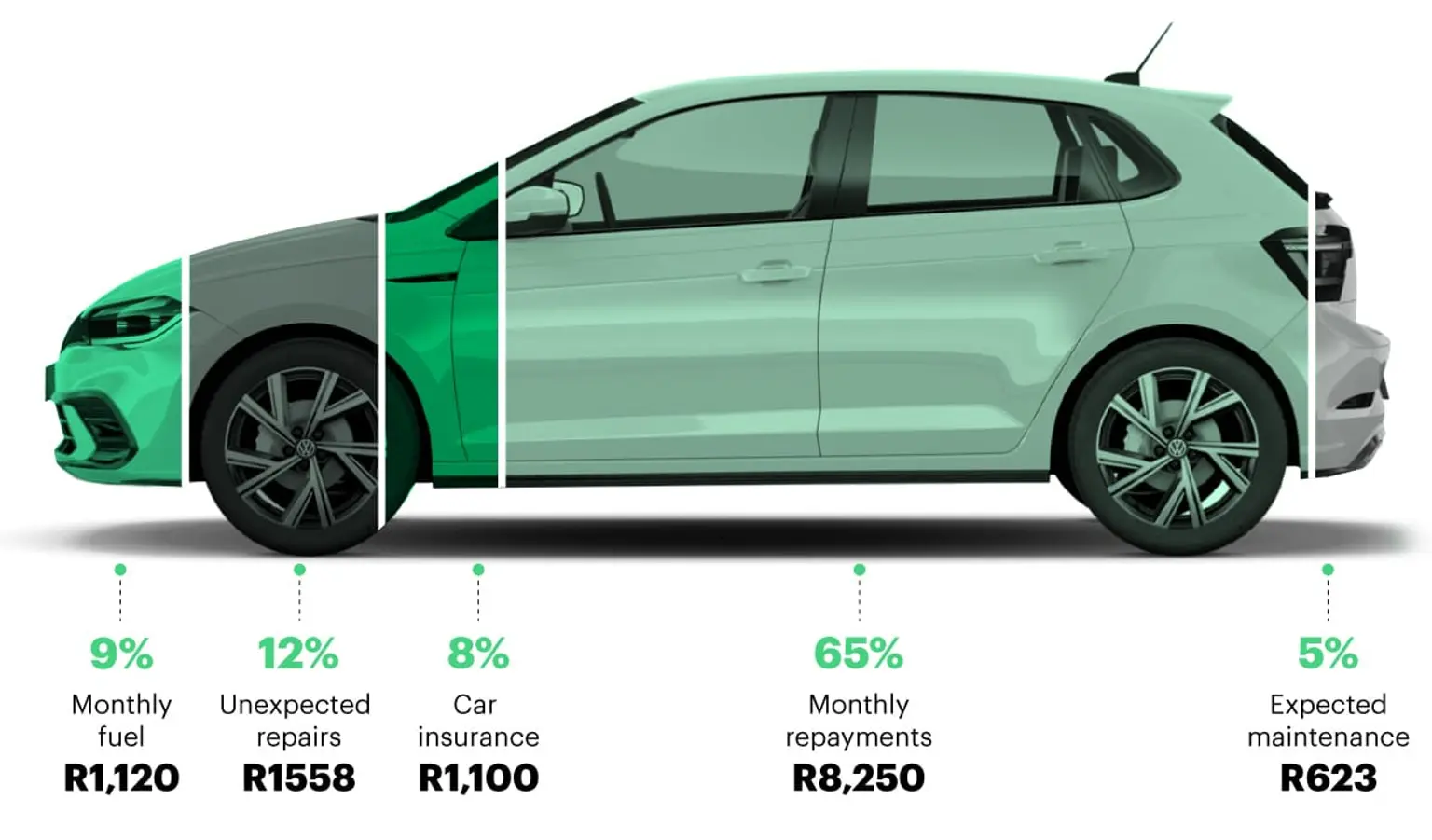
P.S. Figures are estimates. Actual costs will vary based on interest rates, driving habits, mileage, and market conditions, but this gives you a far more realistic starting point than the instalment alone.
A useful affordability rule of thumb
Finance houses often use two simple guidelines when assessing car affordability:
- Your monthly instalment shouldn’t be more than 8–10% of your take-home pay
- Your total monthly car cost (instalment + fuel + insurance + maintenance) shouldn’t exceed 16–20% of your take-home pay
What that looks like in practice
Let’s put some real numbers to it.
If you take home R20,000 a month:
- Instalment guideline (8–10%): R1,600 – R2,000
- Total car cost guideline (16–20%): R3,200 – R4,000
If you take home R30,000 a month:
- Instalment guideline: R2,400 – R3,000
- Total car cost guideline: R4,800 – R6,000
If you take home R40,000 a month:
- Instalment guideline: R3,200 – R4,000
- Total car cost guideline: R6,400 – R8,000
Now compare that to the Polo example above, which comes in at just over R12,000 per month all-in.
That doesn’t automatically mean “don’t buy the car”, but it does mean you should pause and ask whether the trade-off makes sense for your life.
Buying a car isn’t a bad decision. But buying one without understanding the real cost can be an expensive surprise.
If you only look at the instalment, you’re missing half the story. The true cost of owning a car is a mix of monthly cash flow and what that money turns into (or quietly disappears into) over time, through interest, fuel, maintenance, car insurance, and depreciation.
For some people, owning a car makes complete sense. You need it every day; it gives you flexibility, and the monthly cost fits comfortably into your life. For others, a cheaper car, a used option, or mixing ownership with alternatives might buy you more breathing room, financially and otherwise. Either way, it helps to understand what you’re likely to pay for car cover before you commit.
There’s no right answer. But there is a better way to decide.
Do the maths and be honest about what you need. And choose the option that gives you the most freedom, not just the nicest spec sheet.
This article is for general information only and does not constitute financial advice. Always consider your personal circumstances or speak to a qualified financial adviser before making a financial decision.